
Why AI meeting notes are not enough
AI notes tell you what was said after the call. Good conversations depend on the questions you ask during it. Here is why you need a second brain in the room.
Roofle team · · 6 min read
AI meeting notes have become the default. Open a call, let a bot listen, and get a tidy summary a few minutes after you hang up. It is a real improvement over typing while you talk. But notes solve only half of the problem, and the smaller half.
Notes record what happened. They do nothing for what is happening. The most valuable thing you can do in a conversation is ask the right question at the right moment, and no summary written afterwards can do that for you.
What AI notes do well
Credit where it is due. A good AI note taker gives you a searchable transcript, a summary, and a list of action items. You stop scribbling, you stop asking people to repeat themselves, and you can share a recap in minutes.
That is useful. It is also entirely backward-looking. By the time the summary arrives, the call is over and the moment to dig deeper has passed.
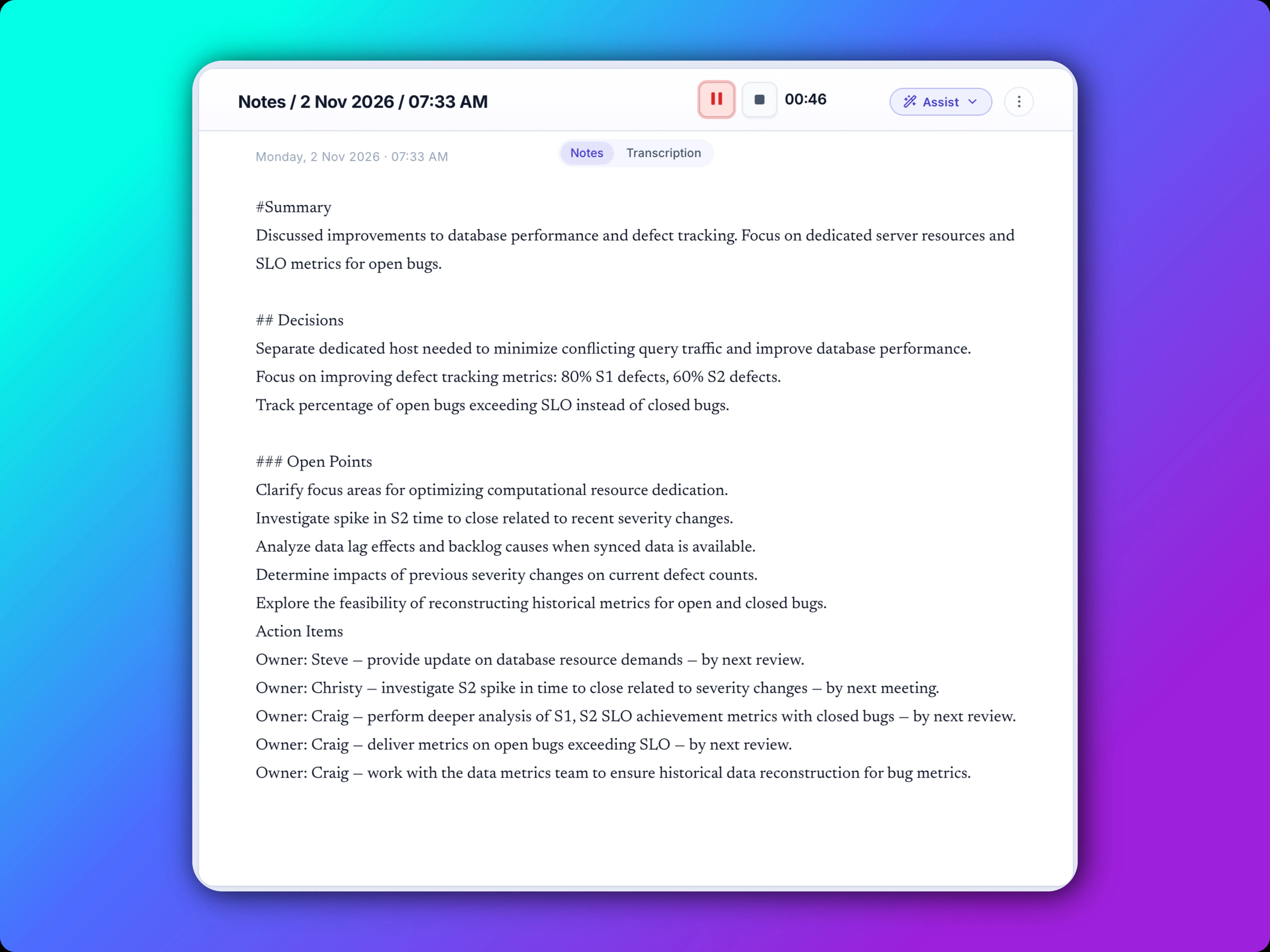
The gap: notes arrive after the conversation ends
Think about the last call where you hung up and thought, "I should have asked about that." The customer mentioned a deadline in passing. The candidate gave a vague answer about a past project. A teammate said "it should be fine" about a risky release.
A summary of that call faithfully records the vague answer. It does not tell you the answer was vague. It does not tell you what to ask next. The notes are accurate and the conversation was still a missed opportunity.
Why relying on instinct to ask questions fails
Most of us rely on instinct. We assume the right question will occur to us when it matters. Some days it does. Many days it does not, and there are ordinary reasons why.
You are doing three things at once. You listen, you think about your reply, and you watch the clock. Spare attention for noticing what was left unsaid is limited.
Some days are off days. Tired, distracted, or back-to-back on a sixth call, your instinct is the first thing to go quiet. The quality of your questions swings with your energy, not with the importance of the meeting.
Social pressure shuts you up. Asking for clarification can feel like interrupting, or admitting you did not follow. So you nod and move on.
You think of it too late. The best follow-up often comes to you in the shower, an hour after the call, when it is no longer useful.
The result is that we end up as passive participants. We hold the call, but we are not driving it. We listen, wait for our turn, and rely on notes to catch what we missed.
Why asking questions matters
Questions are how conversations produce value. Almost every outcome people want from a call, whether a decision, a deal, a hire or a fix, depends on the quality of what was asked.
Questions surface what people do not volunteer. People tell you what they think is relevant. A good question reaches the part they did not think to mention, which is often the part that matters.
Questions expose assumptions. "What would have to be true for this to work?" turns a hidden assumption into something the group can look at and test.
Questions build trust. When you ask a specific follow-up about something the other person said earlier, they know you were listening. Generic questions do the opposite.
Questions prevent expensive mistakes. A thirty-second clarification in a meeting is far cheaper than a rework cycle two weeks later.
Questions move the conversation forward. They turn a status update into a decision, and a decision into an owner and a date.
How different roles depend on questions
Every role that spends its day in conversations lives or dies by what it asks. Here is how that looks across the roles Roofle is built for.
| Role | What questions do for them | What a missed question costs |
|---|---|---|
| Sales | Uncover budget, timeline, decision makers and the real objection | A deal stalls on something nobody asked about |
| Recruiter | Probe past a rehearsed answer to see how a candidate actually works | A bad hire, or a great candidate passed over |
| Customer success | Find the early signs of churn behind a polite "all good" | A surprise cancellation |
| Product manager | Dig from a feature request down to the real problem | A roadmap built on a symptom |
| Founder | Learn what customers and investors will not say unprompted | Months spent building the wrong thing |
| Software professional | Pin down requirements, constraints and risks before building | Rework, and incidents later |
Sales. Discovery is the whole job. The rep who asks one more question about the buying process often finds the blocker that would have killed the deal in week six.
Recruiters. Candidates prepare for the standard questions. The signal sits in the follow-up: "What was your specific part in that?" Missing it means judging a rehearsed answer.
Customer success. Customers rarely say "we are thinking of leaving." They say "things are fine, just busy." A well-timed question turns that into a real conversation.
Product managers. A feature request is usually a proxy for a problem. Asking "what are you trying to get done?" is what separates a useful roadmap from a pile of requests.
Founders. Early customer calls are the cheapest research you will ever get, but only if you ask questions that invite honest answers rather than polite ones.
Software professionals. Ambiguity in a planning call becomes a bug in production. The questions that feel pedantic in the meeting are the ones that save the sprint.
You need a second brain working behind the scenes
If instinct is unreliable and notes arrive too late, what is left is support during the call. Think of it as a second brain: something that listens alongside you, follows the conversation closely, and quietly helps you stay active in it.
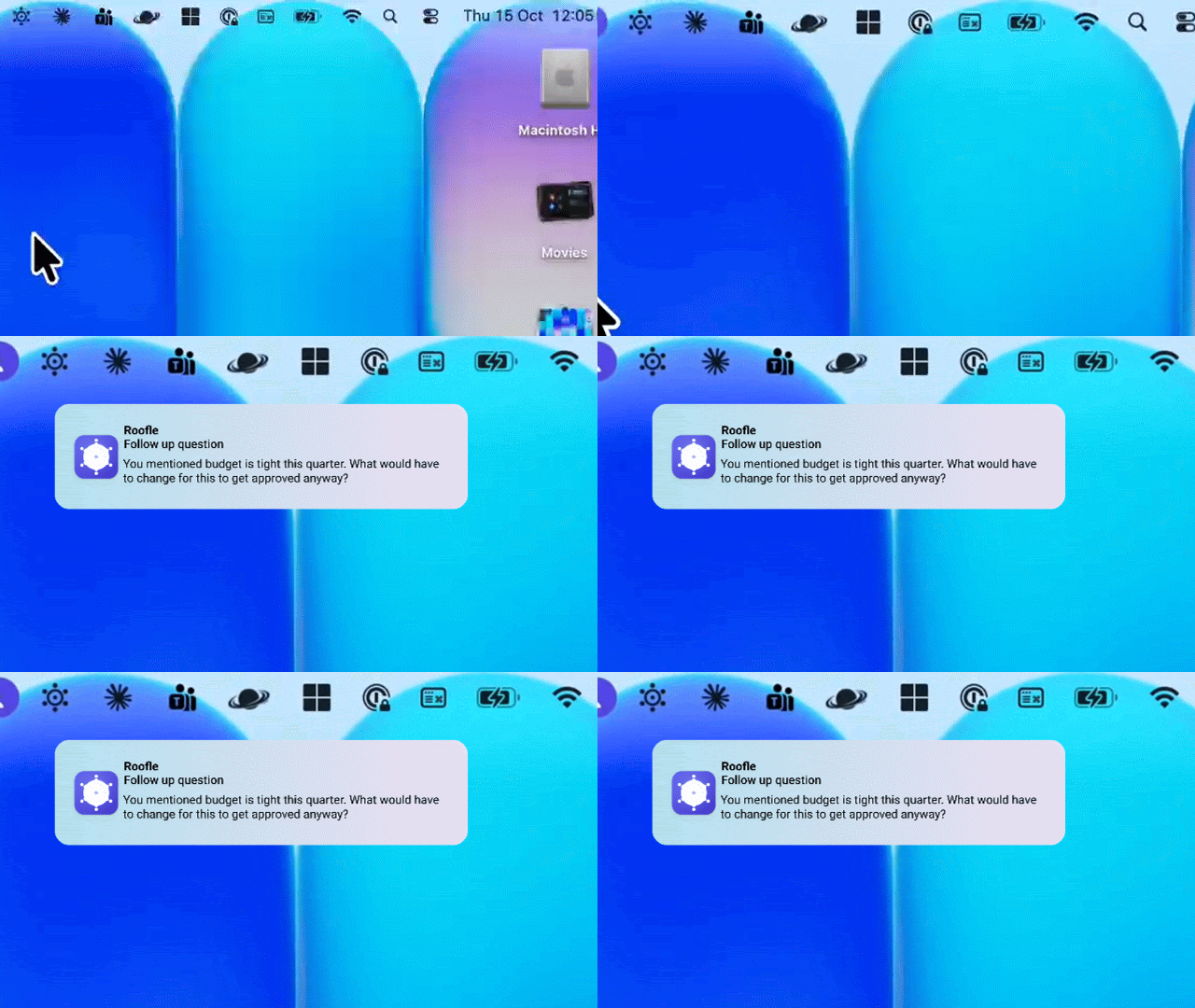
That is different from a note taker in three ways.
It works live. It reads the conversation as it happens, not as a transcript afterwards. A suggestion is only useful while the topic is still on the table.
It prompts rather than records. Instead of summarising what was said, it points to what was left unsaid: a number nobody confirmed, a name nobody mentioned, an answer that did not quite answer the question.
It leaves you in charge. You decide whether to ask, rephrase, or ignore the suggestion. The goal is not to talk for you. It is to free your attention so you can take part fully.
How Roofle does this
Roofle is a free, open-source meeting copilot for your Mac. It transcribes on your device, keeps live notes, and suggests questions you could ask while the conversation is still going. When the call ends, you get the recap, the key dates and the action items as well, so you keep what notes give you and add what they cannot.
Speech to text runs on your Mac, and you choose the model that writes the suggestions. See what Roofle costs for how that plays out in practice.
Notes and a copilot are not rivals
This is not an argument against notes. You still want a record, and a good summary saves real time. The point is that a record is where a conversation ends up, not where its value is created.
| AI notes only | Notes plus a live copilot | |
|---|---|---|
| When it helps | After the call | During and after the call |
| What it gives you | What was said | What was said and what to ask next |
| Your role in the call | Passive listener | Active participant |
| Missed follow-ups | Found out afterwards | Caught in the moment |
Get started
Next time you join a call, notice how often a good question crosses your mind a minute too late. Then try running a conversation with a second brain beside you. Download Roofle, connect a model using the setup guide, and follow the quick start to run your first live session.