
How Roofle helps QA engineers
Roofle is a free, open-source meeting copilot for macOS. How QA engineers use live notes, suggested questions and action items in refinement, triage and sign-off calls, with no bot.
By Priyanshu Shekhar, Founder of Roofle · · 10 min read
Roofle is a free, open-source (MIT) meeting copilot for macOS that helps QA engineers ask better questions, keep a record of what was agreed, and share updates afterwards. It transcribes calls on your Mac, suggests follow-up questions, writes live notes and turns the call into action items. No bot joins, and it works with your own LLM key or a local model.
Last updated 27 November 2026. Covers Roofle v2.0.0 (Apple Silicon build).
QA is a conversation job
A QA engineer's output is not only test cases and bug reports. Much of the work happens in meetings: backlog refinement, sprint planning, bug triage, stand-ups and release sign-off. In those rooms, QA has three jobs that have nothing to do with running a test:
• Ask. Find the gaps in a requirement before anyone writes code.
• Track. Remember what was decided, and what changed since the last conversation.
• Share. Tell the team what you found, what is blocked and what is next.
The ISTQB Agile Tester syllabus describes testers as working directly with developers and business stakeholders to clarify requirements for testability, consistency and completeness. That is a talking job, and it has the same problem as any talking job: you cannot listen carefully, write everything down and think of the next question all at once.
Roofle is aimed at that problem. It sits beside you during the call so your attention can stay on the conversation.
Need one: asking the questions nobody else asks
Questions are the cheapest test you will ever run. A well-known piece on StickyMinds puts it this way: one of the most useful things a tester can do is ask good questions early, to help the rest of the team think clearly.
The standards bodies agree. The ISTQB Agile Tester syllabus says testers help improve user stories by finding missing details and non-functional requirements. They ask business representatives open-ended questions, propose ways to test each story and confirm acceptance criteria. It adds that a team can refuse a story that is too vague, and that the business side must answer the team's questions about each story.
The Three Amigos conversation, from the Ministry of Testing glossary, gives the tester a specific focus: what could go wrong, and what about the edge cases. The meeting should end with concrete examples and clear acceptance criteria. TechTarget adds that testers' questions reach into technical requirements such as integrations, performance and security.
The cost of skipping this is old news but still worth knowing. A NIST report on the economics of inadequate software testing found that over half of software bugs are not found until "downstream" in the development process. It put the annual cost to the US economy at $59.5 billion. That figure is a 2002 estimate extrapolated from case studies, so treat it as a signal of scale, not a precise number.
Where Roofle fits
The hard part of asking is timing. The best question often occurs to you while someone is mid-sentence, and by the time they finish it is gone. Or you are writing down their last point and miss the gap in it.
Roofle suggests follow-up questions while the meeting is happening, in a panel beside your notes, and sends a notification when a new one appears. On roofle.app, the example is discovery calls, where Roofle looks for gaps such as budget, timeline and decision-makers. The same idea carries into a requirements conversation: something was said, something is missing, and a prompt points at it.
Treat the suggestions as a second pair of ears, not as your test strategy. You still decide what is worth asking.
A question checklist to hold suggestions against
This is a working method, not Roofle output. Keep a short list of question types in your head or on a sticky note. When a suggested question lands, or when you notice the conversation has skipped a category, you know what to ask.
| Category | A question to ask | Why it matters |
|---|---|---|
| Acceptance criteria | How will we know this story is done? What would a failing case look like? | Turns a vague story into something testable. |
| Edge cases and limits | What happens with zero, one, the maximum, and one more than the maximum? | Boundaries are where most bugs live. |
| Data and state | What does the user see the first time, and after they have changed their mind? | Surfaces empty, partial and stale states. |
| Failure and errors | What should happen when the service is down or the input is wrong? | Exception paths are rarely written down. |
| Non-functional | How fast, how secure, how accessible does this need to be? | Performance, security and accessibility are common gaps. |
| Integrations | Which other systems does this touch, and who owns them? | Integration points hide risk. |
| Scope | What are we deliberately not doing in this release? | Prevents arguments at sign-off. |
Several categories come straight from the sources above: edge cases and "what could go wrong" from the Three Amigos approach, and non-functional requirements and integrations from the ISTQB and TechTarget material. The rest are common testing practice. A good habit is to glance at the table before each refinement session and note which rows the discussion has not yet touched.
Need two: keeping track of what was discussed
QA lives downstream of every decision. A requirement changes in a Tuesday call, a developer agrees to "handle that case later", the product owner narrows the scope. If you didn't catch it, you find out on Friday when a test fails for a reason nobody remembers.
Testing has a formal name for this discipline: traceability. NIST's security glossary defines a traceability matrix as a matrix that records the relationship between two or more products of the development process, such as requirements and design. In testing, the common use is linking requirements to the test cases that check them. A matrix only works if the requirement it points to is still the right one, and requirements move in conversations.
The same goes for bug triage. Atlassian's bug triage guide says triage should leave behind written criteria for prioritising and assigning bugs, plus a tracking entry for each bug with the details of its fix. It also notes that a ticket should close only after testing confirms the fix. Those records start as spoken decisions: this one is a blocker, that one can wait, you own this.
Where Roofle fits
Roofle keeps a transcript of the call and a set of live notes on your Mac, and lists past meetings in a panel on the left. When you are unsure what was agreed, you can reopen the meeting and check, instead of relying on memory or on a teammate's recollection.
A habit that makes this useful: at the end of any meeting where requirements or priorities moved, spend two minutes scanning the notes for changes. Update the ticket, the acceptance criteria or the test plan while the call is fresh. The transcript is your backup for the moments you cannot reconstruct.
Roofle is not a traceability tool, and it does not link anything to your test management system. It records the conversation. You still maintain the matrix.
Need three: sharing updates
Testing that nobody hears about might as well not have happened. The ISTQB Agile Tester syllabus lists the usual ways testers communicate status in agile teams: moving tasks across the board, burndown charts, wiki dashboards, dashboard-style emails and verbal updates. It also notes that the daily stand-up includes testers, and that each person covers what they completed, what they plan to complete and what is blocking them. Blockers that affect test progress are raised so the whole team can resolve them.
There is a pattern in that list. Most of it is writing a short summary after something happened. Triage is the same. Atlassian recommends assigning an owner as soon as a bug is categorised and prioritised, so nobody is confused about who is working on what, and sharing context in advance so meeting time goes to decisions.
Where Roofle fits
When a call ends, Roofle can turn it into action items with one click. That gives you the raw material for the update: what was decided, who owes what, what is blocked.
A simple structure for the update you send afterwards, borrowed from the stand-up format above:
• Done: what was covered or confirmed in the meeting.
• Next: the action items and who owns them.
• Blocked: open questions that stop testing, and who needs to answer.
That template is yours, not a Roofle output format. Roofle does not list integrations today, so you copy the action items into Slack, Jira or wherever your team keeps them.
Which role to pick
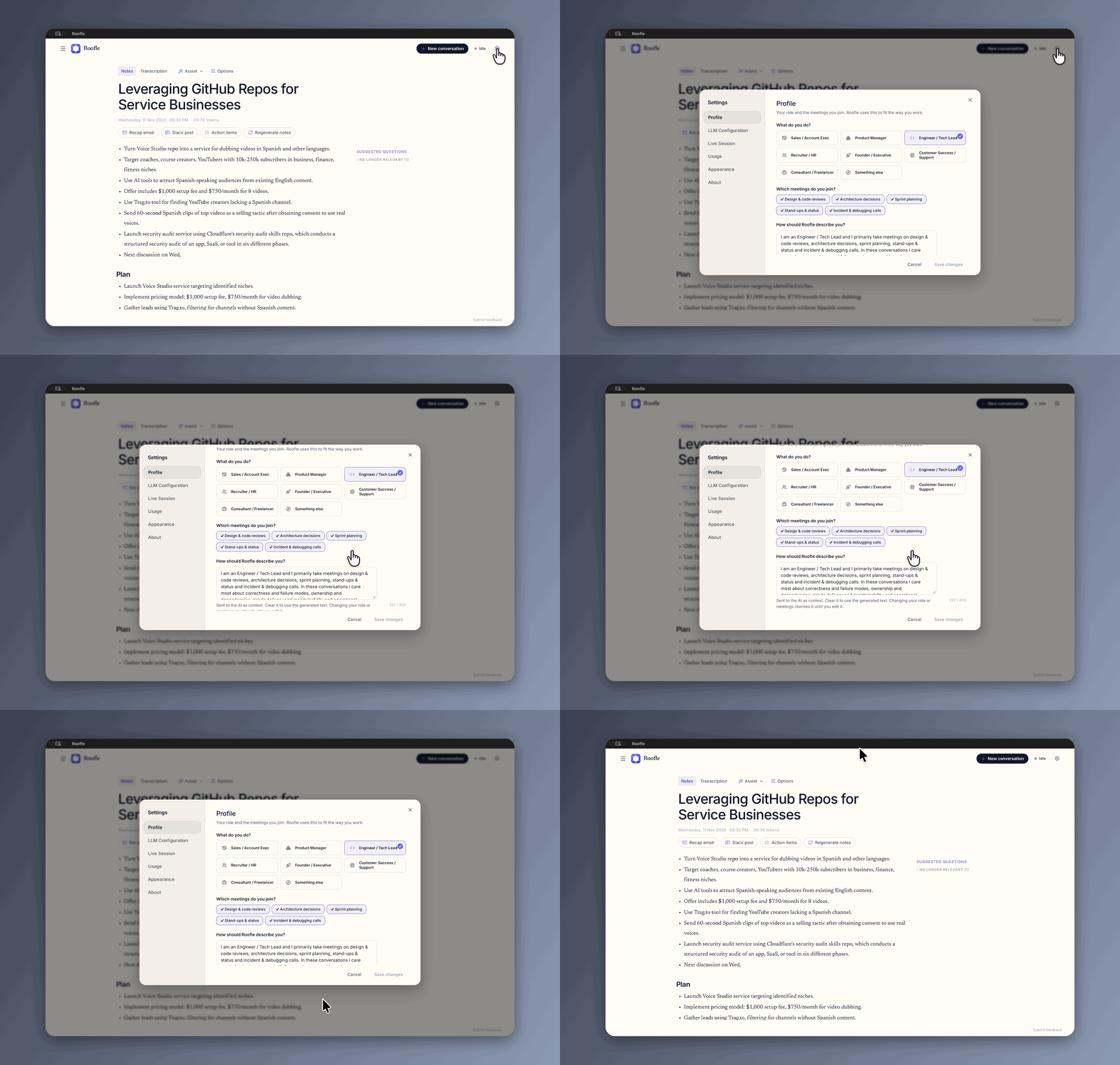
Before a call, Roofle asks you to choose a role. The role changes what it listens for and what it suggests. The six options on roofle.app are Sales, Recruiter, Product Manager, Founder, Customer Success and Software Professional.
There is no QA role. The closest fit is Software Professional, so that is the one to start with. Try it on a low-stakes refinement call and see whether the suggested questions line up with the checklist above. If they don't, that is useful feedback for the project.
A QA week, meeting by meeting
The table is an illustration of how ask, track and share play out in four common meetings. It is not output from a real call.
| Meeting | Ask | Track | Share |
|---|---|---|---|
| Backlog refinement or Three Amigos | What are the acceptance criteria? What are the edge cases? | Scope changes and the examples agreed | Updated acceptance criteria on the story |
| Sprint planning | Is this story testable in this sprint? What is the risk? | Which stories were accepted and which were declined as too vague | Testing effort and risks flagged to the team |
| Bug triage | Can anyone reproduce it? Who is affected? | Severity, priority and owner for each bug | The triage decisions, posted where the team looks |
| Release sign-off | What is still open? What did we choose not to fix? | Known issues accepted by the business | A short release status with open risks |
In each row, Roofle's job is the same. It lets you stay in the conversation while it records what was said.
Privacy matters in QA calls
QA conversations carry sensitive material. Unreleased builds, security bugs that haven't been fixed, customer data used to reproduce an issue, and the occasional test credential read out loud. A hosted note-taker that joins as a bot and sends the audio to a vendor's servers is a hard sell for that content.
Roofle's setup is different:
• No bot joins the call. Other participants don't see an extra attendee.
• Transcription is on-device. Speech-to-text runs on your Mac, and transcripts are stored there.
• You control what leaves. Only text you choose to send goes to your chosen LLM. With a local model, nothing leaves your machine.
• The code is open. It is MIT-licensed on GitHub, so you or your security team can read it.
Two habits still apply. Don't read passwords or tokens aloud on any call, because a transcript will keep them. And tell participants up front that you are transcribing, since recording rules differ by country and state. Check your company's policy before using any recording tool.
Who it suits, and who it doesn't
Best for: QA engineers, SDETs and test analysts on a Mac who spend their days in refinement, planning and triage conversations, and want a quiet note-taker with no bot in the call.
Not a fit if:
• You work on Windows. Many QA teams do. Roofle is macOS only for now, and Windows is planned, not available.
• You need notes linked to test cases. Roofle doesn't connect to test management tools or Jira today.
• You need a formal, auditable record for a regulated environment. Roofle is a v1 side project, not a compliance product.
• You want a shared team workspace where everyone edits the same notes.
The AI features need a language model. You bring your own API key and pay your provider, or run a local model on your Mac.
Get started
1. Download the .dmg from roofle.app and drag Roofle to Applications. Or install the Homebrew cask.
2. Open Roofle from the menu bar and pick the Software Professional role.
3. Add your LLM API key, or point Roofle at a local model, then start your next call.
macOS will ask for microphone and audio-capture permission the first time. The current build is for Apple Silicon (v1.0.0). Try it first on a refinement call where the stakes are low.
Frequently asked questions
How does Roofle help a QA engineer? It takes live notes, suggests follow-up questions, keeps a transcript on your Mac, and turns the call into action items. That covers asking, tracking and sharing in meetings.
Does Roofle have a QA role? No. The roles are Sales, Recruiter, Product Manager, Founder, Customer Success and Software Professional. Software Professional is the closest fit.
Can it help in refinement and Three Amigos sessions? That is a good use. Live notes let you listen, and suggested questions point at gaps while the conversation is still going. You decide which questions are worth asking.
Can it replace my test management tool? No. Roofle records conversations. It doesn't hold test cases, link requirements to tests or track execution.
Does it connect to Jira, TestRail or Slack? Roofle doesn't list integrations today. You copy action items into your tool of choice.
Does a bot join my calls? No. Roofle captures your microphone and system audio on your Mac.
Is it safe for calls about unreleased builds or security bugs? Transcription and transcript storage are on your Mac. Only text you choose to send goes to your chosen LLM, and with a local model nothing leaves your machine. Check your company's policy first.
Does it work on Windows? Not yet. Windows support is planned.
Is it free? Roofle is free and MIT-licensed. You pay only your LLM provider if you use your own API key.
Sources
Checked 27 November 2026.
• The Economic Impacts of Inadequate Infrastructure for Software Testing, NIST, 2002
• Traceability matrix, NIST Computer Security Resource Center glossary
• ISTQB Certified Tester Foundation Level Agile Tester syllabus v1.0, ISTQB
• Bug triage: A guide to efficient bug management, Atlassian
• Three Amigos, Ministry of Testing glossary
• The key role testing plays in a Three Amigos strategy, TechTarget
• The Demons of Ambiguity, StickyMinds
• Questions you should probably ask as QA, M Rizwanur Rashid, LinkedIn
• 7 Things Awesome Testers Do That Don't Look Like Testing, Simon Knight, LinkedIn
• Post on QA challenges, Rozil A., LinkedIn
• Ahmed Mekawy's LinkedIn activity, LinkedIn
From the maker
I'm building Roofle on my own, in my spare time. It's early, and it will have rough edges. If you are a tester and something in your workflow doesn't fit, tell me. Open an issue on GitHub or write to support@roofle.app.
• Site: roofle.app
• Source: github.com/roofle-ai/roofle
• License: MIT